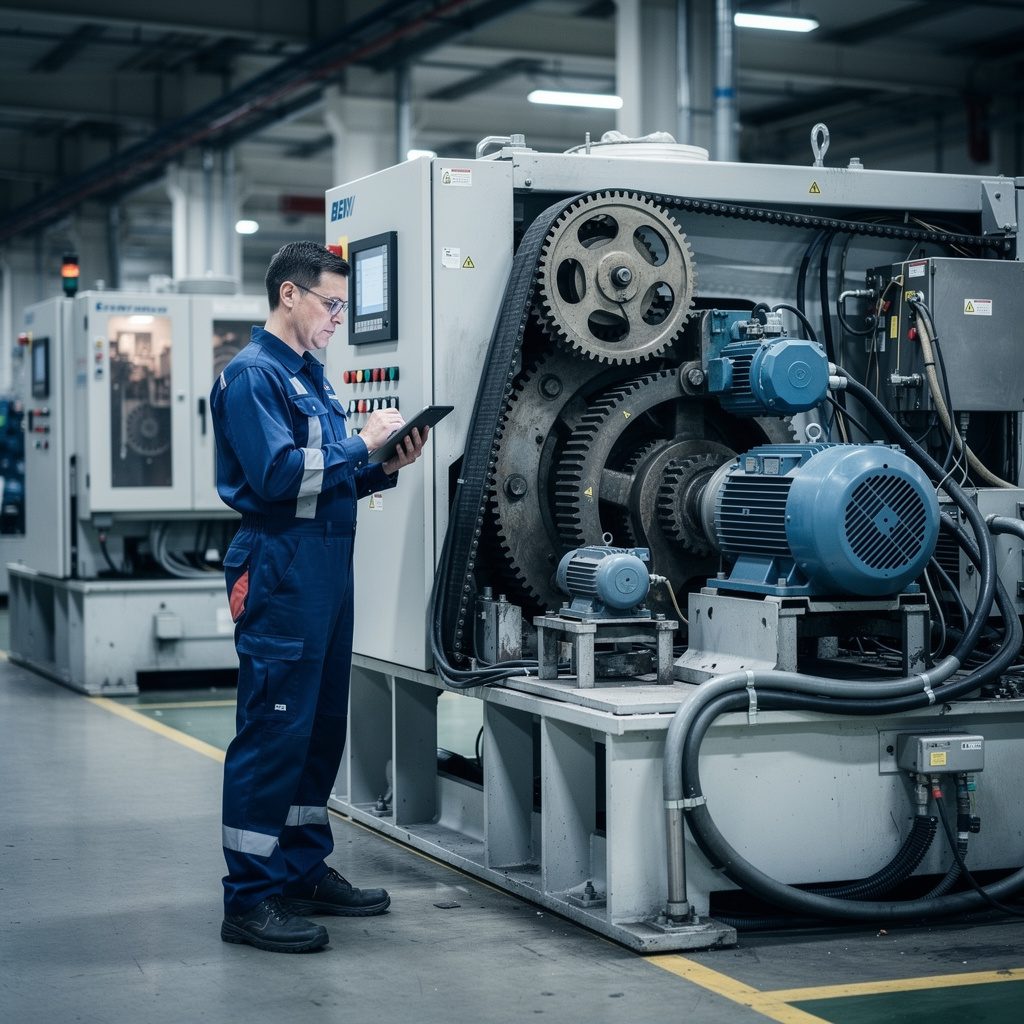
Industrial Equipment Downtime: Causes and Practical Fixes
A practical look at what actually causes industrial equipment downtime and how maintenance teams can reduce it before it happens.
A stamping press that stops mid-shift doesn't just lose the hour it's down. It loses the setup time to restart, the batch that was mid-run, and often a slot in the next machine's schedule too. Downtime rarely stays contained to one station.
Most plants treat breakdowns as isolated events. A bearing seizes, a belt snaps, a sensor gives a false reading, and the fix gets logged as a one-off. Looked at over a year, though, the same three or four failure types tend to repeat across different machines in the same facility.
Where Downtime Actually Starts
Few failures happen without warning. A motor that trips usually ran hot for weeks before it quit. A conveyor that jams often had a slightly misaligned roller for months. The failure is the final step in a chain that started much earlier and went unnoticed.
The hard part isn't spotting these warning signs after the fact — it's catching them while the machine is still running normally. Vibration creeping up by a fraction, current draw rising slightly, cycle times stretching by a second or two. None of these trigger an alarm on their own.
Operators who've worked a line for years often sense this kind of drift before any dashboard does. That instinct is valuable, but it doesn't scale across three shifts or multiple sites, which is why more plants are pairing operator judgment with continuous sensor logging.
Data You Already Have but Don't Use
Most industrial equipment already produces more data than anyone reviews. PLCs log fault codes, drives record current and temperature, and SCADA systems store historical trends going back months or years. The gap usually isn't collection — it's review.
A simple starting point: pull six months of fault codes for your worst-performing machine and sort by frequency. In many shops, two or three codes account for most of the stoppages, and they point to the same root cause every time — a filter that clogs, a seal that wears faster than spec, a sensor mounted where it collects debris.
Once that pattern is visible, the fix is often mechanical or procedural, not technological. Swap the filter on a shorter interval. Move the sensor six inches. Add a wipe-down step to the shift handover. These changes cost little and prevent the failures that used to eat a shift a month.
Building a Maintenance Schedule That Actually Holds
A maintenance calendar only works if it survives contact with a busy production week. Plenty of schedules exist on paper and get skipped whenever the line is running behind, which is usually the exact week that skipped task turns into a breakdown.
Tying maintenance windows to production counts rather than calendar dates tends to hold up better. Instead of "every Friday," use "every 40,000 cycles." That way the task moves with actual machine use, not with a date that gets pushed when orders pile up.
It also helps to separate tasks by consequence. A five-minute visual check on a conveyor guard can happen daily without much planning. A bearing replacement that needs the line down for two hours needs its own slot, ideally during a scheduled changeover rather than squeezed into a gap.
Sourcing Parts Before You Need Them
Even a well-run maintenance program falls apart if the replacement part isn't on the shelf when the old one fails. Lead times on specialized modules — control boards, sensor assemblies, drive components — can run from days to several weeks depending on the manufacturer and current demand.
Teams that get ahead of this usually keep a short list of critical spares tied directly to their failure-frequency data from earlier, rather than stocking everything in the catalog. When a component shows up repeatedly in fault logs, it earns a spot in that list before it fails again. Some maintenance groups now handle this kind of proactive sourcing online, checking specs and lead times ahead of the actual breakdown so they can buy milk3 units the same week a warning sign appears rather than after the line has already stopped.
That shift — from reactive ordering to planned sourcing — often does more to cut downtime than any new sensor or software dashboard. The equipment itself rarely changes overnight; the timing of decisions around it does.
Plants that treat spare parts as part of the maintenance schedule, not a separate emergency budget line, tend to see fewer surprise stoppages within a few months. It's a small process change, but it closes the gap between spotting a problem and actually fixing it before it costs a shift.