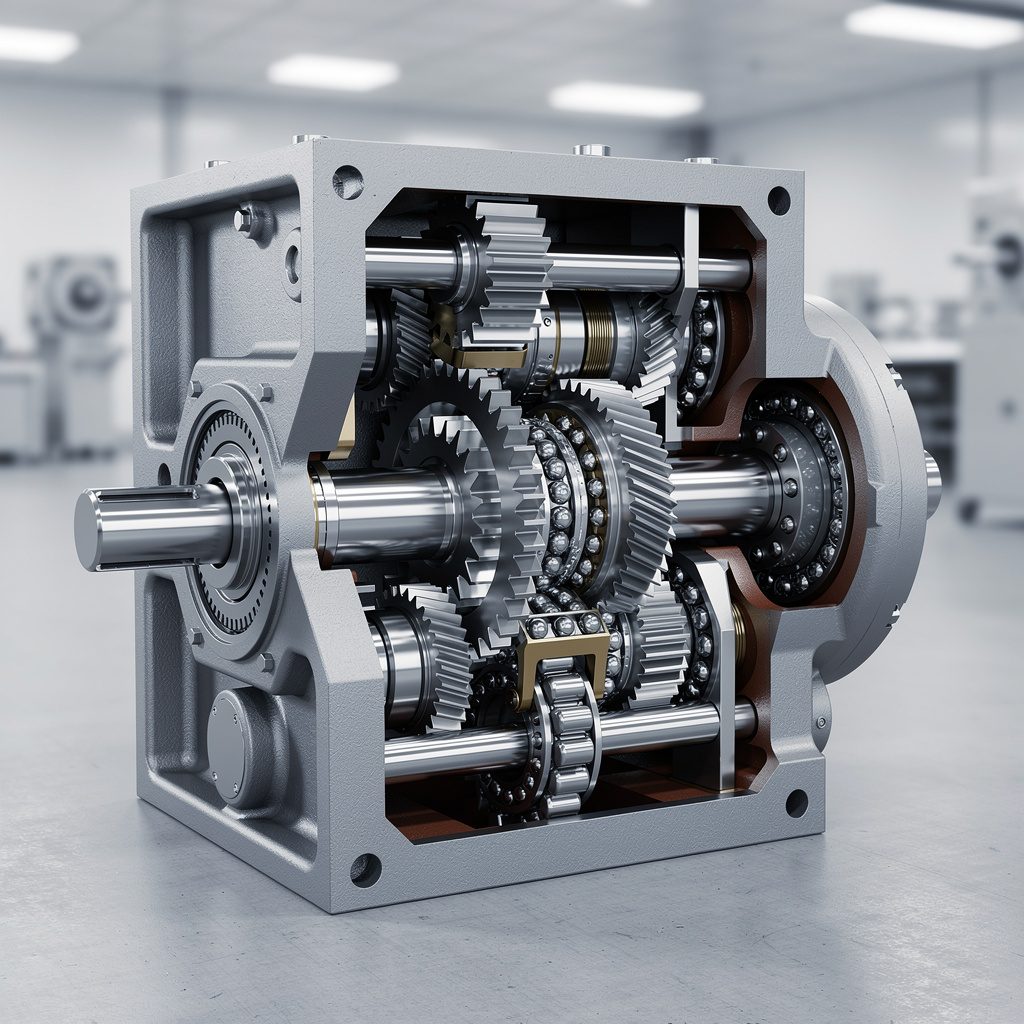
How to Pick the Right Gearbox for Your Machine
A practical guide to selecting industrial gearboxes based on torque, ratio, service factor and duty cycle, with real numbers to check against.
A gearbox that looks fine on paper can still fail in six months if the duty cycle was guessed instead of calculated. Most premature gearbox failures trace back to three numbers that got skipped during selection: output torque, service factor, and thermal rating. Get those wrong and no amount of oil changes will save the unit.
Start With Output Torque, Not Horsepower
Motor catalogs sell horsepower, but gearboxes fail from torque. The formula is simple: torque (Nm) equals 9550 times power (kW) divided by output speed (rpm). A 15 kW motor driving a conveyor at 20 rpm output needs roughly 7,160 Nm at the output shaft — not the 60-70 Nm you'd calculate at motor speed.
This matters because catalog ratings are almost always listed by torque capacity at a given speed, not by horsepower alone. If you size by horsepower and skip the torque check, you can end up with a gearbox that's mechanically undersized even though the power rating looks adequate.
Always request the output torque curve from the manufacturer, not just the nameplate rating. Some units drop capacity sharply below 10 rpm due to lubrication limits on the slow-speed gear mesh.
Service Factor Is Not a Safety Margin You Can Skip
Service factor (SF) accounts for shock loads, starts per hour, and duty cycle — it's a multiplier applied to your calculated torque before you pick a frame size. AGMA and most manufacturers use tables based on load classification: uniform, moderate shock, or heavy shock.
A bucket elevator with frequent jams gets classified as heavy shock, often requiring SF of 1.5 to 2.0. A smooth, continuously loaded fan might only need 1.0 to 1.25. Picking the wrong category is the single most common reason gearboxes fail within the first year of continuous operation.
Check starts-per-hour too. A gearbox rated for 10 starts/hour used on an application with 40 starts/hour will overheat at the bearings long before the gears show wear, even if torque calculations look fine.
Match Thermal Rating to Ambient Conditions, Not Catalog Defaults
Every gearbox has a mechanical torque rating and a separate thermal rating — the maximum power it can dissipate as heat without overheating the oil. In enclosed housings or high-ambient environments (above 40°C), thermal rating often becomes the real limiting factor, not torque.
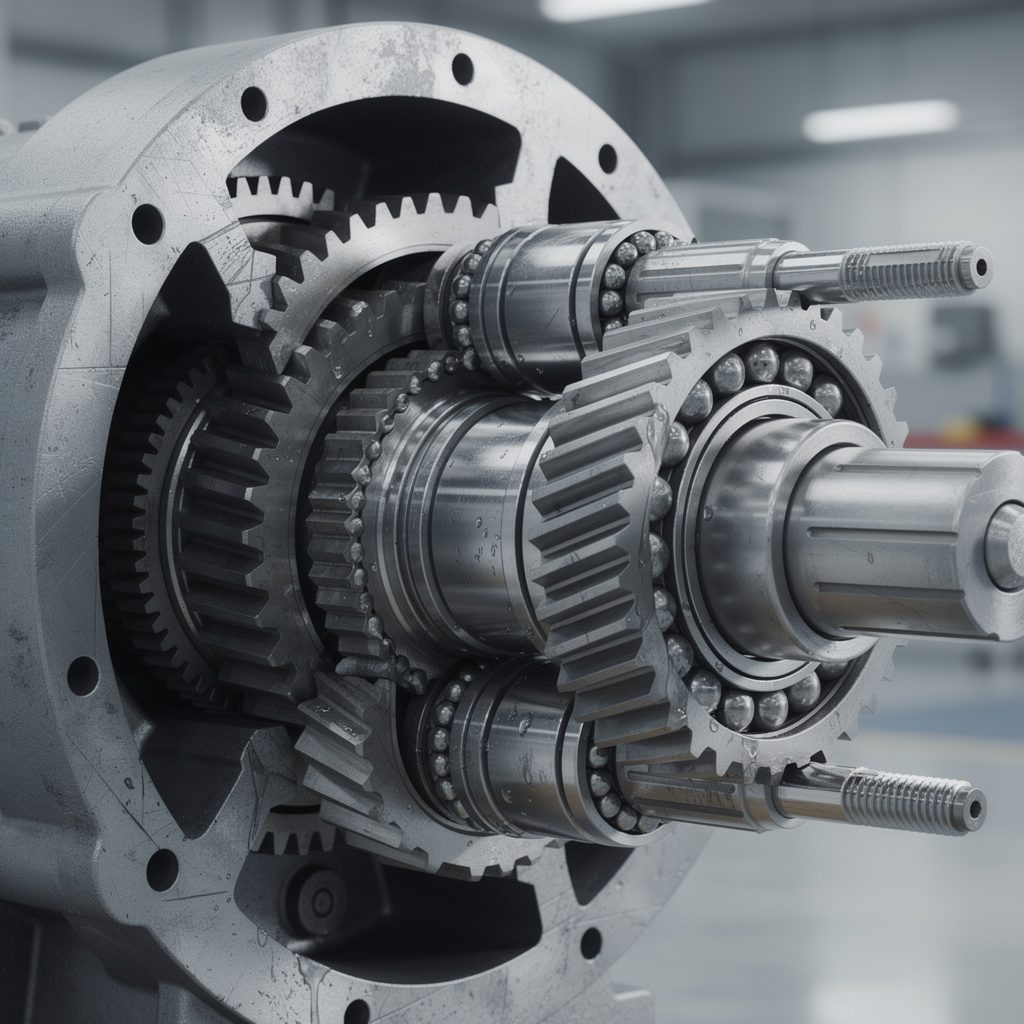
A gearbox mechanically capable of handling 50 kW might only be thermally rated for 35 kW continuous duty in a 45°C ambient with no forced cooling. Manufacturers list thermal derating curves, but they're easy to miss because they're usually on a separate page from the torque tables.
If your gearbox sits in an enclosed cabinet, near a furnace, or in direct sun in a hot climate, request the derated thermal capacity specifically for your ambient temperature. Adding a cooling fan accessory can recover 15-20% of thermal capacity for a few hundred dollars — cheap insurance against oil breakdown and seal failure.
Ratio Selection Affects Efficiency More Than Most Buyers Expect
Higher ratios generally mean more gear stages, and each stage costs roughly 1-2% in mechanical efficiency. A single-stage helical gearbox might run at 97-98% efficiency, while a triple-stage worm-helical combination can drop to 85-90%.
On a 30 kW drive running continuously, that efficiency gap translates to 3-4.5 kW of wasted energy — enough to matter on an electricity bill over a year of three-shift operation. When two ratio options can both meet your speed requirement, the one with fewer stages usually wins on lifetime energy cost, even if the upfront price is slightly higher.
Worm gear sets are the exception worth watching. They're compact and quiet but rarely exceed 90% efficiency even in a single stage, and that number drops further as the gearbox wears in. For continuous heavy-duty operation, helical or helical-bevel designs almost always beat worm gearing on total energy cost over five years.
Don't Skip the Mounting and Backlash Check
Output shaft configuration — solid shaft, hollow shaft with shrink disc, or hollow shaft with keyway — affects both installation labor and long-term reliability. Shrink disc mounts eliminate keyway stress concentrations and are worth the extra cost on high-cycle applications like crushers or shredders.
Backlash matters most on positioning applications: indexing tables, robotics interfaces, or anything with frequent direction reversals. Standard industrial gearboxes carry 15-30 arc-minutes of backlash, while precision planetary units can get below 5 arc-minutes at a significant price premium.
If your application only runs one direction most of the time, standard backlash specs are fine and there's no reason to pay for precision gearing you won't use.