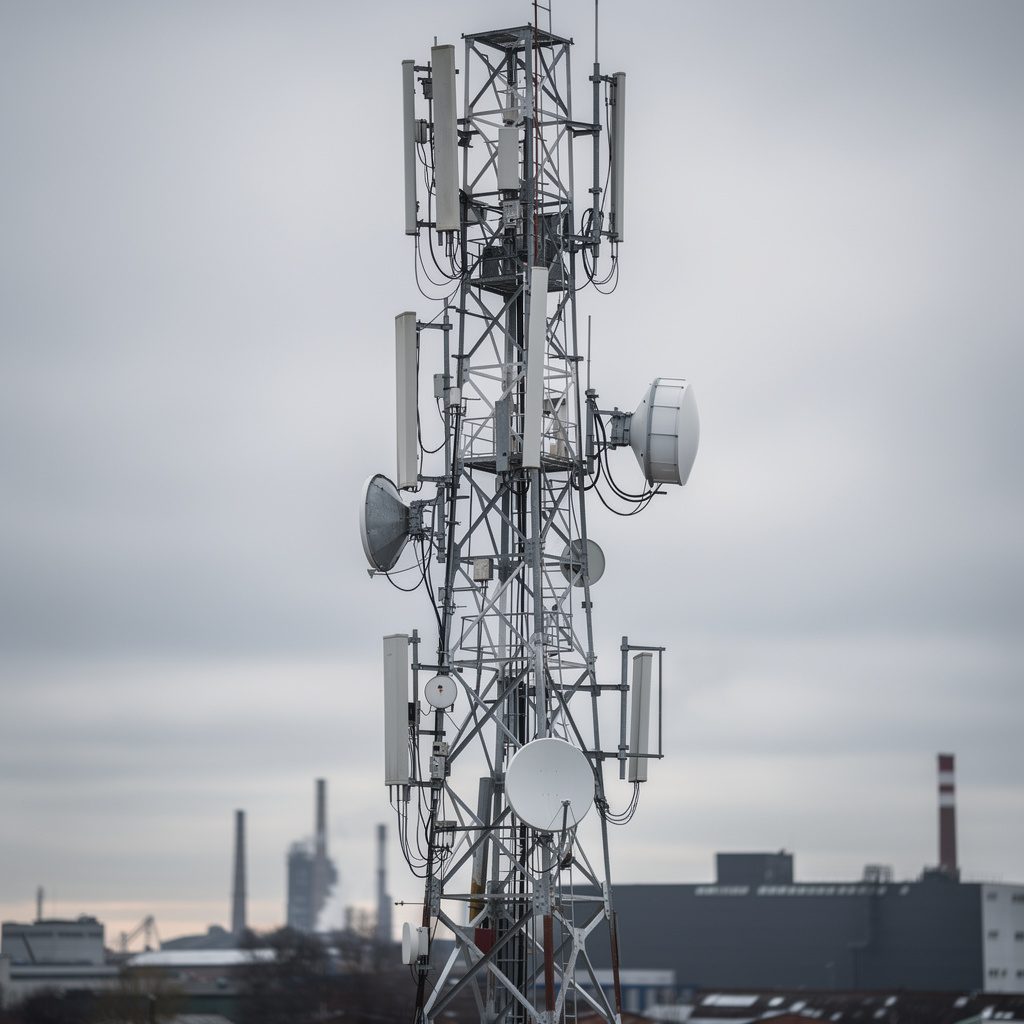
How to Pick an Industrial Antenna Without Guesswork
A practical breakdown of frequency, gain, mounting, and environmental factors for selecting industrial antennas that actually perform in the field.
Most antenna selection mistakes happen before anyone opens a datasheet. An integrator picks a model because it worked on a previous job, or a buyer chooses the cheapest option that matches the frequency band on paper. Six months later the link drops every time it rains, and nobody can explain why.
Start With the Link Budget, Not the Catalog
Before comparing antenna models, calculate what the link actually needs. Take your transmitter power, subtract cable and connector losses, add required receiver sensitivity margin, and you get the gain figure the antenna must deliver.
A typical example: a 900 MHz SCADA link running 1 watt of output power over 15 meters of LMR-400 cable loses roughly 1.5 dB in the cable alone. If the receiver needs -95 dBm and you're transmitting at +30 dBm, you have almost 125 dB of budget to work with — plenty of room, so a compact 3 dBi antenna might be enough. A 5.8 GHz point-to-point link over 20 km has none of that slack, and every dB from a high-gain parabolic dish matters.
Skipping this step means guessing. Guessing means either overpaying for gain you don't need or underbuilding a link that fails under load or bad weather.
Match Antenna Type to the Physical Environment
Omnidirectional antennas make sense when you need coverage in all directions from a single point — a warehouse Wi-Fi backbone, a fleet tracking base station, a sensor hub collecting data from scattered field units. They trade gain for coverage angle, typically running 3-9 dBi.
Directional antennas — panels, yagis, parabolic dishes — concentrate energy into a narrow beam. A 24 dBi parabolic dish at 5 GHz can push a reliable link 30+ km point-to-point, something no omni can do. But that beam width narrows to a few degrees, which means mounting has to be precise and stable.
Sector antennas sit between the two: 60-120 degree horizontal coverage with more gain than an omni, common in cellular and private LTE base stations covering a defined zone like a port terminal or mining site.
The environment also dictates radome material and mounting hardware. Coastal installations need antennas rated for salt fog exposure, not just IP65 dust and rain protection. Petrochemical sites often require ATEX or IECEx certification because a spark from a loose connector near flammable vapor is not a theoretical risk.
Frequency Band Determines More Than Range
Lower frequencies travel farther and penetrate obstacles better, but the antennas needed to achieve useful gain get physically larger. A 450 MHz omni with 6 dBi gain runs about 1.2 meters long. A 5.8 GHz omni with the same gain fits in 20 centimeters.
Higher frequencies pack more bandwidth, which matters for anything moving video or large data volumes, but they're more sensitive to rain fade and line-of-sight obstruction. A 24 GHz link that works perfectly in dry conditions can lose several dB during heavy rain — sometimes enough to drop the connection if the link budget wasn't sized with a fade margin.
Regulatory limits also vary by band and region. The 2.4 GHz ISM band has power limits that differ between FCC and ETSI rules, and licensed bands like 700 MHz LTE require coordination with a spectrum authority before deployment. Check this before specifying hardware, not after it arrives.
Mechanical and Environmental Ratings Matter as Much as RF Specs
An antenna with perfect RF performance is useless if it fails mechanically within a year. Wind load rating tells you whether the antenna and its mount will survive local conditions — a rooftop installation in a region with 150 km/h gusts needs a different mechanical rating than a sheltered indoor deployment.
Temperature range matters for outdoor equipment in continental climates. Some standard-grade antennas are only rated to -20°C, which cracks radomes in northern winters. Industrial-grade units typically extend to -40°C or lower.
Ingress protection ratings (IP65, IP67) tell you about dust and water resistance, but they say nothing about UV stability. Cheap plastic radomes degrade and turn brittle after a few years of direct sun exposure, even if the IP rating looked fine on paper.
Talk to the Manufacturer Before You Order
Catalog specs describe an antenna in ideal test conditions, not on your tower, in your climate, with your cable run and your interference sources nearby. A brief conversation with an engineer who can review your link budget, site photos, and frequency plan usually catches problems that a spec sheet comparison misses.
For non-standard requirements — unusual mounting geometry, custom frequency ranges, extreme environmental exposure — a made-to-order design often costs less over the equipment's lifetime than adapting an off-the-shelf unit that wasn't built for the job.